Updated with recent remarks from the Federal Reserve minutes
G7 central banks are assessing the uncertainty around the Iran war and holding rates steady. The cautious stand comes after supply disruptions across the Strait of Hormuz jolted energy markets, pushing up oil prices.
Despite a two-week ceasefire, economic risks persist, with the International Monetary Fund (IMF) head warning that the conflict will drive higher inflation and slower growth even if hostilities ease.
Uncertainty means higher inflation risk, which could further delay interest rate cuts.
G7 countries have increased the number of urgent meetings to tackle the economic consequences of the Iran war, which has just entered its second month.
Conflict in the Middle East is testing the resilience of the global economy, according to the Organization for Economic Cooperation and Development (OECD). In its recent periodic update, OECD warned that central bankers need to be ‘vigilant’ to ensure that inflation expectations remain well anchored.
Energy costs remain a key pressure point for central banks and as a result, the Federal Reserve, Bank of Japan, European Central Bank, Bank of Canada and the Bank of England have kept interest rates unchanged, as they evaluate inflation risks amid an uncertain outlook.
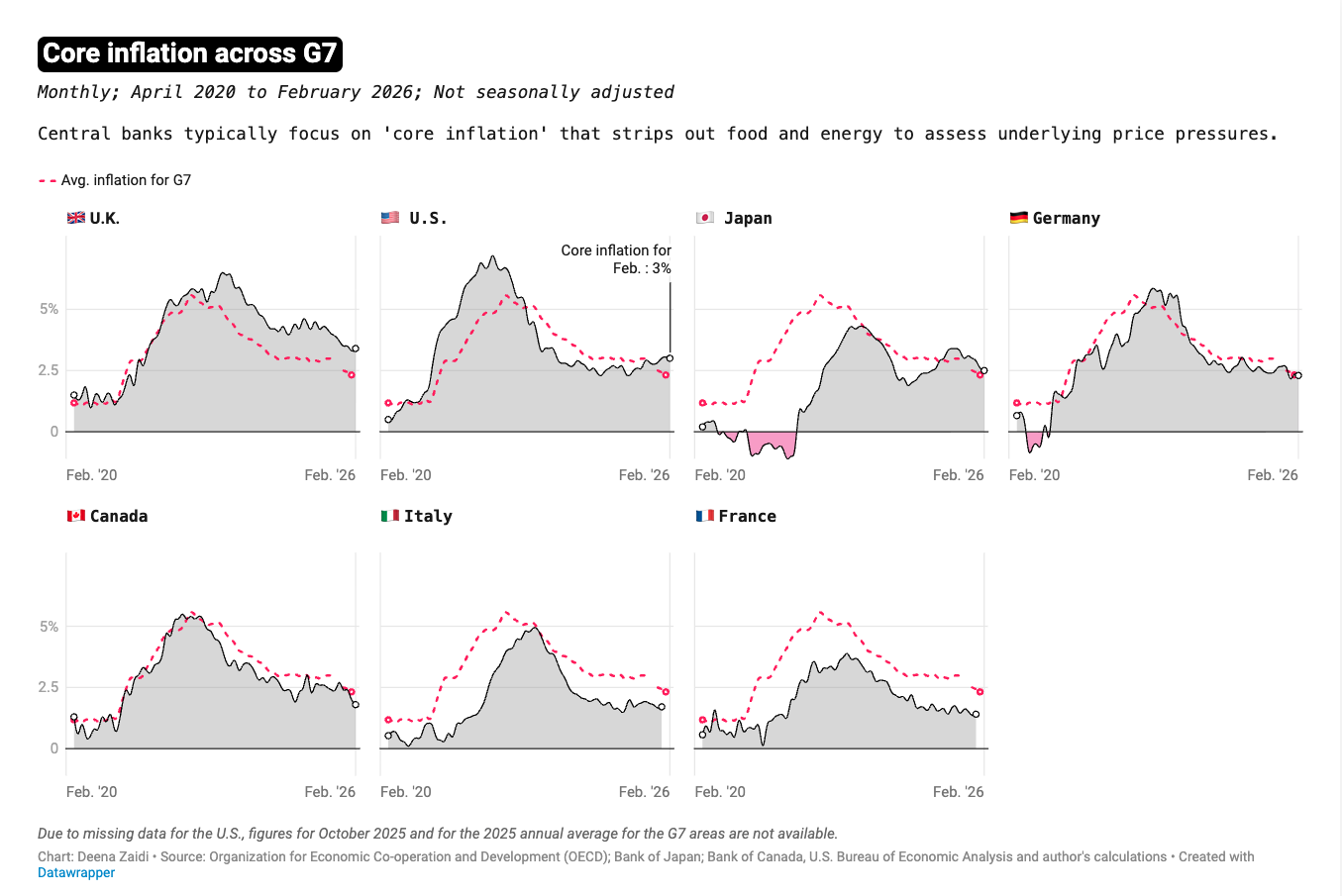
Central banks typically look at core inflation, which strips out energy and food costs, since these are highly volatile. But the spillover of rising oil prices into the headline inflation cannot be ignored since it means rising transportation costs, rising gas prices and high food prices.
The Federal Reserve left the interest rates unchanged at 3.5%-3.75%. For over 18 months, the Fed was leaning towards cutting interest rates. Earlier meetings alternated between cuts and no change to rates but with the war, uncertainty around energy and food prices could mean a slow shift toward, leaving room for potential hikes this year, contrary to market expectation.
During the press conference held after the monetary policy decision in March, Chair Jerome Powell emphasized that the effects of developments in the Middle East on the US economy are “uncertain”, noting the energy shock pulled inflation expectations up.
Gasoline prices in the U.S. crossed $4 a gallon, reflecting a shock from the rising oil markets. OECD projects headline U.S. inflation to be at 4.2% in 2026, a sharp jump from its prior projection of 2.8%.
Policy rates for the Bank of Japan were also left unchanged at 0.75%. Governor Kazuo Ueda said that the board is more focused on the upside risks tied to inflation than the downside risks to growth arising from the conflict. Earlier in March, Japan introduced a curb on gas prices to safeguard against rising energy prices. “We will take these points into account in determining the degree to which rising oil prices could weigh on the economy through worsening terms of trade,” Ueda said in a press conference.
The Bank of Canada maintained its policy rate at 2.25%, saying the war in Middle East had heightening the risks to the global economy due to the increased volatility in global energy prices. A summary of deliberations released on April 1 shows that that the central bank’s decision-makers will use their best “judgment” on how to respond to the conflicting economic signals tied to the Iran war.
The war has delayed interest rate cuts for the U.K. due to the country’s sensitivity to energy price fluctuations. OECD predicts U.K. to be the worst hit by the Iran war than its G7 peers since it imports most of its oil and natural gas. In the past the Bank of England had made six cuts since August 2024 but held its rate at 3.75% in March. With the ongoing war in the Middle East, the monetary policy committee is anticipating higher than expected inflation and rising energy costs that could slow down he economy.
Interest rates for three (Germany, Italy and France) of the G7 members are governed by the European Central Bank (ECB) and the officials have decided to keep ECB interest rates unchanged, largely due to the war uncertainty around the war. The Bank expects energy prices to be higher, projecting overall core inflation in the region to stand at an average of 2.3% in 2026.