UAE is leaving the OPEC (Organization of the Petroleum Exporting Countries) after six decades.
In its announcement, the UAE said short-term disruptions in the Arabian Gulf and the Strait of Hormuz may affect oil supply, but long-term global energy demand is still expected to grow.
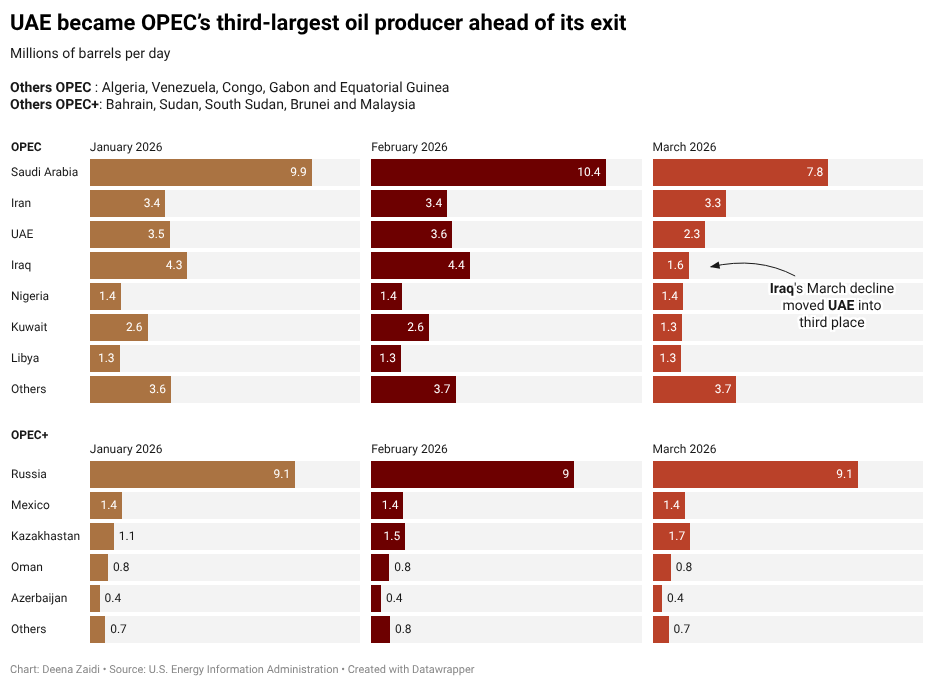
Oil traders watch the oil cartel for co-ordinated supply cuts. In March this year, UAE’s oil production levels surpassed Iraq’s. UAE’s departure from OPEC will test the cartel unity and could reshape the oil influence across the Gulf. Lately, the oil cartel has seen its market power weaken as the U.S. increased its production of crude oil in recent years.
Currently, OPEC has a total of 12 Member Countries. UAE’s departure leaves OPEC with 11 countries.
OPEC has a long history of member countries leaving, rejoining only to join back later.
The organization was founded in Iraq by five countries namely Iran, Iraq, Kuwait, Saudi Arabia and Venezuela in September 1960. Later, the cartel was joined by Qatar (1961), Indonesia (1962), Libya (1962), the UAE (1967), Algeria (1969), Nigeria (1971), Ecuador (1973), Gabon (1975), Angola (2007), Equatorial Guinea (2017) and Congo (2018).
- Ecuador suspended its membership in December 1992, rejoined in October 2007 and decided to withdraw its membership of OPEC effective Jan. 1, 2020.
- Indonesia suspended its membership in 2009, reactivated it in January 2016, but decided to suspend its membership once more in November 2016.
- Gabon terminated its membership in 1995. but it rejoined OPEC in July 2016.
- Qatar terminated its membership on 1 January 2019.
- Angola withdrew its membership effective 1 January 2024.