Prolonged elevated oil prices tied to tensions around the Strait of Hormuz are pushing gas prices higher across the U.S.
Priced at roughly $100 per barrel, this could accelerate electric vehicle (EV) adoption, even as charging costs vary widely across states.
According to AAA, the national average gas price climbed to about $3.95 a gallon as of March 22, with some regions seeing increases of more than 80 cents in recent weeks. Gas prices rise quickly when oil prices increase but tend to fall more slowly when they decline, a phenomenon known as rockets and feathers.
Data from Edmunds, a car buying platform, shows that EVs accounted for 22.4% of all vehicle research activity in the week starting March 2, up from 20.7% the previous week. The increase was largely driven by stronger interest in battery electric vehicles.
Because gas prices only began rising sharply toward the end of that period, the shift in shopper behavior is likely still in its early stages.
EV adoption in the U.S.
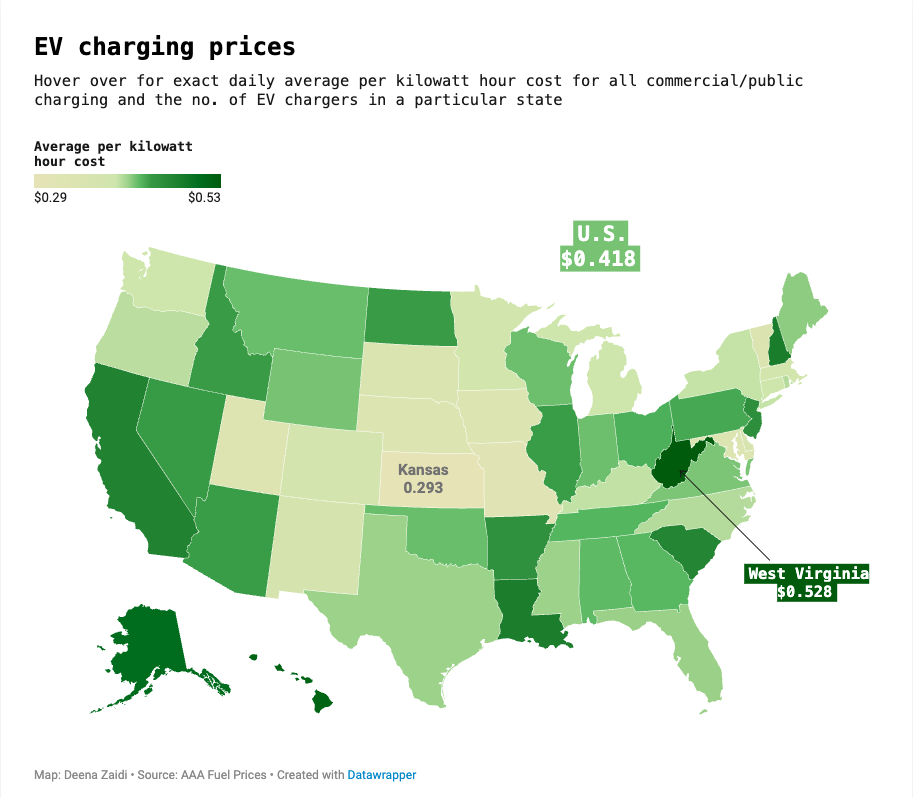
While rising fuel costs are increasing pressure on drivers, whether this translates into EV adoption depends heavily on local charging economics. EV adoption remains uneven nationwide and charging costs differ widely, with some states seeing significantly higher per-kilowatt-hour prices than others.
California has the strong EV presence with more than 27,000 EV charging stations with charging cost of $0.47 per kilowatt-hour (/kWh). This is in contrast with West Virginia, which has the highest EV charging cost in the country, at $0.528/kWh, despite having only 280 public chargers. Kansas has lowest charging cost of $0.293/kWh with 651 charging stations.
What’s next?
If oil prices remain elevated, the shift toward EVs could accelerate, but uneven charging costs and infrastructure may determine where that transition happens fastest.
- High gas prices alone do not guarantee a shift to EVs. Infrastructure availability and charging costs remain key constraints.
- In short, EVs aren’t the emergency fix, but they’re a critical long-term solution to reduce exposure to oil shocks.