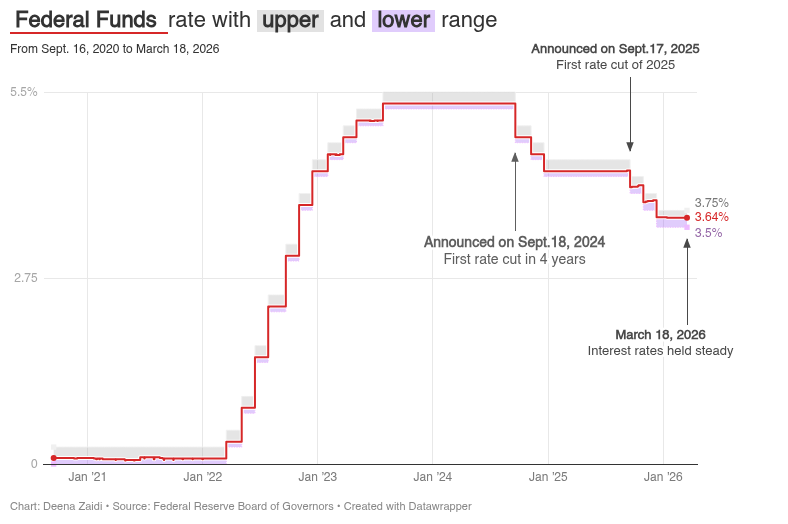
The Federal Reserve decided to maintain the target range for the federal funds rate at 3.5 to 3.75%.
The decision reflects a balancing act between resilient economic growth and persistent inflation pressures.
From last September through December, the Fed had lowered the policy rate 0.75 percentage point.
The U.S. is expanding at a solid pace but the dual mandate of achieving maximum employment and stable prices remains a concern for the central bank-at least in the near term.
Jobs: Job gains have slowed, but the unemployment rate has changed little in recent months. It stood at 4.4% in February and has remained broadly stable since late last summer.
Inflation: Total personal consumption expenditures (PCE) prices rose 2.8% over the year in February. Excluding the volatile food and energy categories, core PCE prices rose 3%. The Fed noted elevated inflation readings in the goods sector, boosted by the tariff impacts.
Uncertainty: The implications of events in the Middle East for the U.S. economy remains uncertain and could be detrimental to the overall inflation.
In the news conference, the Federal Reserve Chair Jerome Powell said,
The implications of developments in the Middle East for the U.S. economy are uncertain. We will remain attentive to risks to both sides of our dual mandate.
One of the biggest concerns remains rising oil prices, which will push up the energy prices, contributing to a high overall inflation. Gas prices have soared due to the ripple effect of the Iran war.
Oil prices climbed above $100 per barrel tensions across the Gulf escalated, triggering supply disruptions creating fresh market volatility.
