Kevin Warsh takes over the Federal Reserve at a moment when central banks across the globe are cautious on their next interest rate move.
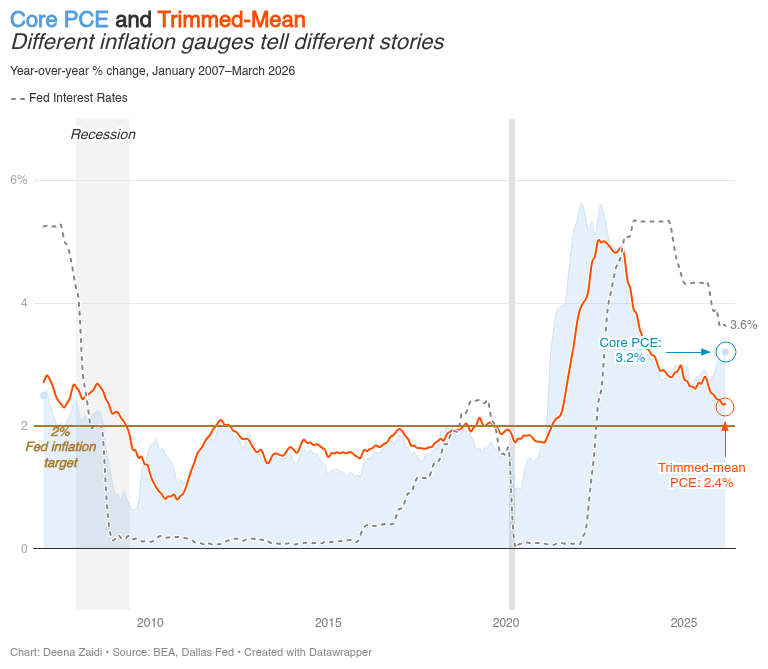
Warsh has repeatedly questioned whether the Fed’s preferred inflation gauge, the core Personal Consumption Expenditures (PCE), accurately reflects underlying price pressures. During his Senate confirmation hearing, he said the data used to judge inflation is “quite imperfect.”
Instead, Warsh has pointed to alternative measures.
Instead of relying primarily on core PCE inflation, Warsh has pointed to alternative gauges such as Dallas Fed’s Trimmed Mean PCE and the Cleveland Fed’s Median CPI as better measures of measuring inflation trends.
The shift toward alternative inflation measures matters because inflation readings closer to the Fed’s 2% target could strengthen the case for earlier interest rate cuts.
Trimmed mean inflation
Developed by the Federal Reserve Bank of Dallas, trimmed mean inflation (unlike core PCE) removes the most extreme price fluctuations each month across all categories and keeps the mean of this trimmed category. This statistical approach cuts off outliers, giving it the flexibility to remove the most volatile elements on a monthly basis.
As of March 2026, core PCE inflation stood at 3.2%, while the Dallas Fed’s trimmed-mean was running at roughly 2.4%, much closer to the Fed’s inflation target.
But the lower reading does not necessarily mean inflation pressures have disappeared. Some economists argue that trimmed-mean measures can miss inflation turning points because the methodology filters out categories experiencing the largest price swings.
During the early stages of the post-pandemic inflation surge in 2021, trimmed-mean inflation initially rose more slowly before broader price pressures spread across the economy.
Median Consumer Price Index
The Cleveland Fed publishes median inflation measures for both CPI and PCE.
Unlike trimmed-mean PCE, median CPI is based on the CPI framework rather than the PCE framework, meaning differences partly reflect methodology and basket composition.
Median CPI was running at roughly 2.8% in April 2026, still below core PCE but notably higher than trimmed mean PCE. Median inflation measures can provide a cleaner signal of persistent price pressures during periods of geopolitical or commodity-driven volatility.
Instead of calculating an inflation rate that is a weighted average of all of the items in the CPI, as the BLS does, the Cleveland Fed ranks the inflation rates of the components of the CPI and picks the one in the middle of the distribution—that is, the item whose expenditure weight is in the 50th percentile of the price change distribution.
Critics warn that greater emphasis on alternative inflation measures could complicate the Fed’s communication strategy, especially if headline inflation remains elevated because of energy or geopolitical shocks.
Bottomline
Inflation has increasingly become a question of statistical interpretation.
The metric Fed chooses could reshape both market expectations and the path of the interest rates under a new leadership. A switch at a time of such uncertainty could only pose huge risks on the economy and markets.