During his visit to Harvard, the former Federal Reserve Chairman Jerome Powell expressed confidence in the resilience of the U.S. financial system but did not shy away from expressing concerns about America’s balance sheet.
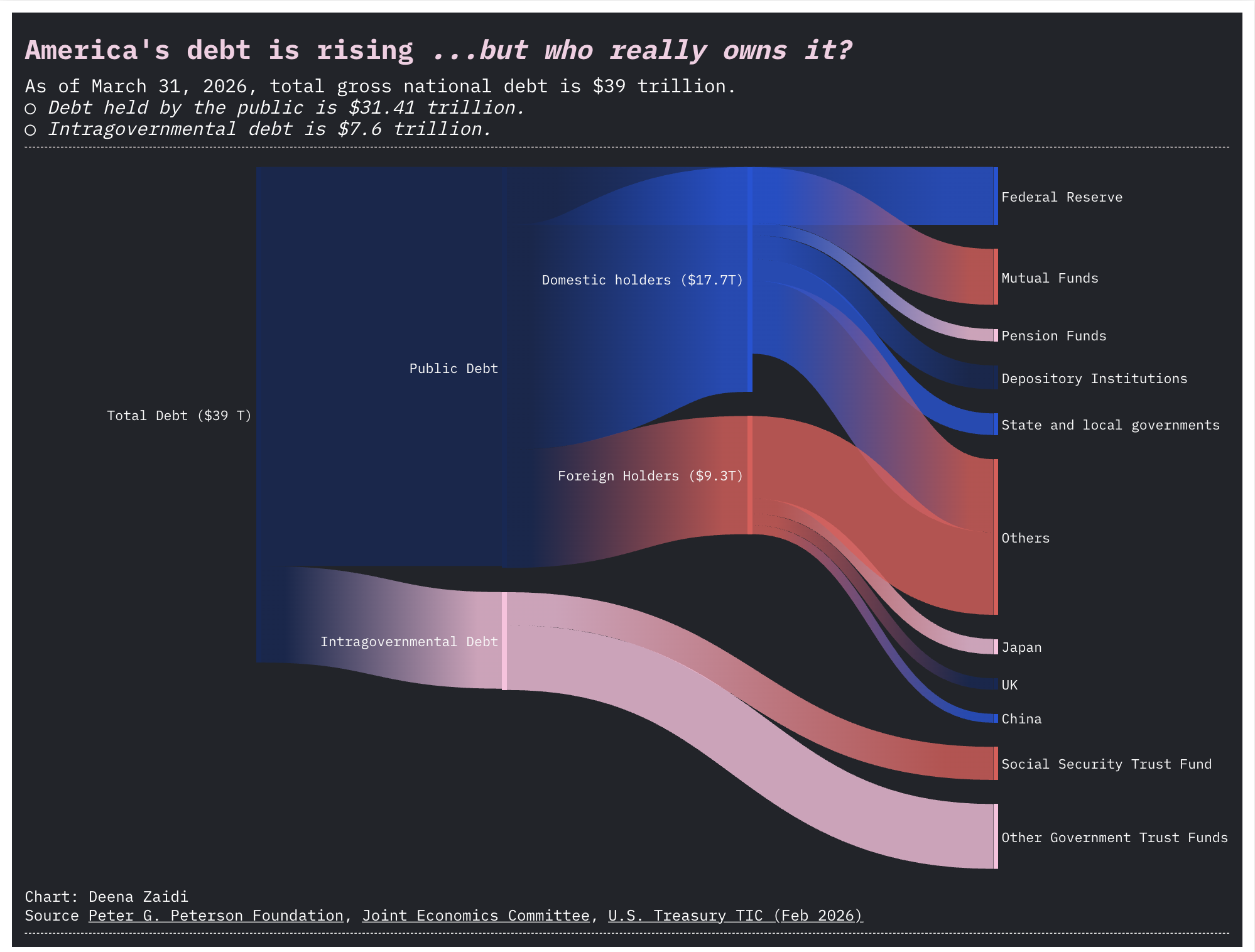
The current gross U.S debt stands at $39 trillion, which Powell says was not the real problem.
Instead, he said, its the current path Congress has taken of spending more than taking in which he feels is “not sustainable.”
Powell’s insights came with a warning, “It will not end well if we don’t do something fairly soon.”
The interest on debt is rising much faster and is the fastest growing part of the U.S. budget. As of April 2026 it costs $734 billion to maintain the debt, which is 17% of the total federal spending in fiscal year 2026.
U.S. debt has been on the rise
U.S. debt touched record levels and is equivalent to the combined value of major economies: China, Germany, Japan, India and the U.K., according to the analysis done by Peter G. Peterson Foundation.
“We’ve heard plenty of alarm bells in the past few years about our fiscal path, but this one rings especially loudly,” according to the Committee for a Responsible Federal Budget, the organization that analyzed the March level of federal debt held by the public as a share of G.D.P.
The International Monetary Fund (IMF) warns that America’s budget deficits will remain above 7% of GDP every year through 2035, the highest sustained level among major economies.
Debt servicing is now among Washington’s biggest expenses.
The government’s annual interest payments have nearly doubled in just three years, surpassing combined federal spending on education and transportation.
Every 1% increase in average interest rates is now adding roughly $380 billion to annual borrowing costs.
Unlike Japan, the U.S. relies heavily on foreign sources and Japan is the largest foreign holder of U.S. government debt. Recently, Japan investors pulled roughly $30 billion out of U.S. government-linked debt in the first quarter of 2026. This was also the country’s biggest quarterly sale since Q2 of 2022.
With U.S. Treasury yields on the rise, it might be worth reevaluating whether America’s financial power is beginning to change.