As U.S. national debt approaches $39 trillion, a significant share of foreign demand is concentrated among a small group of countries.
Foreign investors added more than $100 billion in long-term U.S. securities in February, driven largely by private demand.
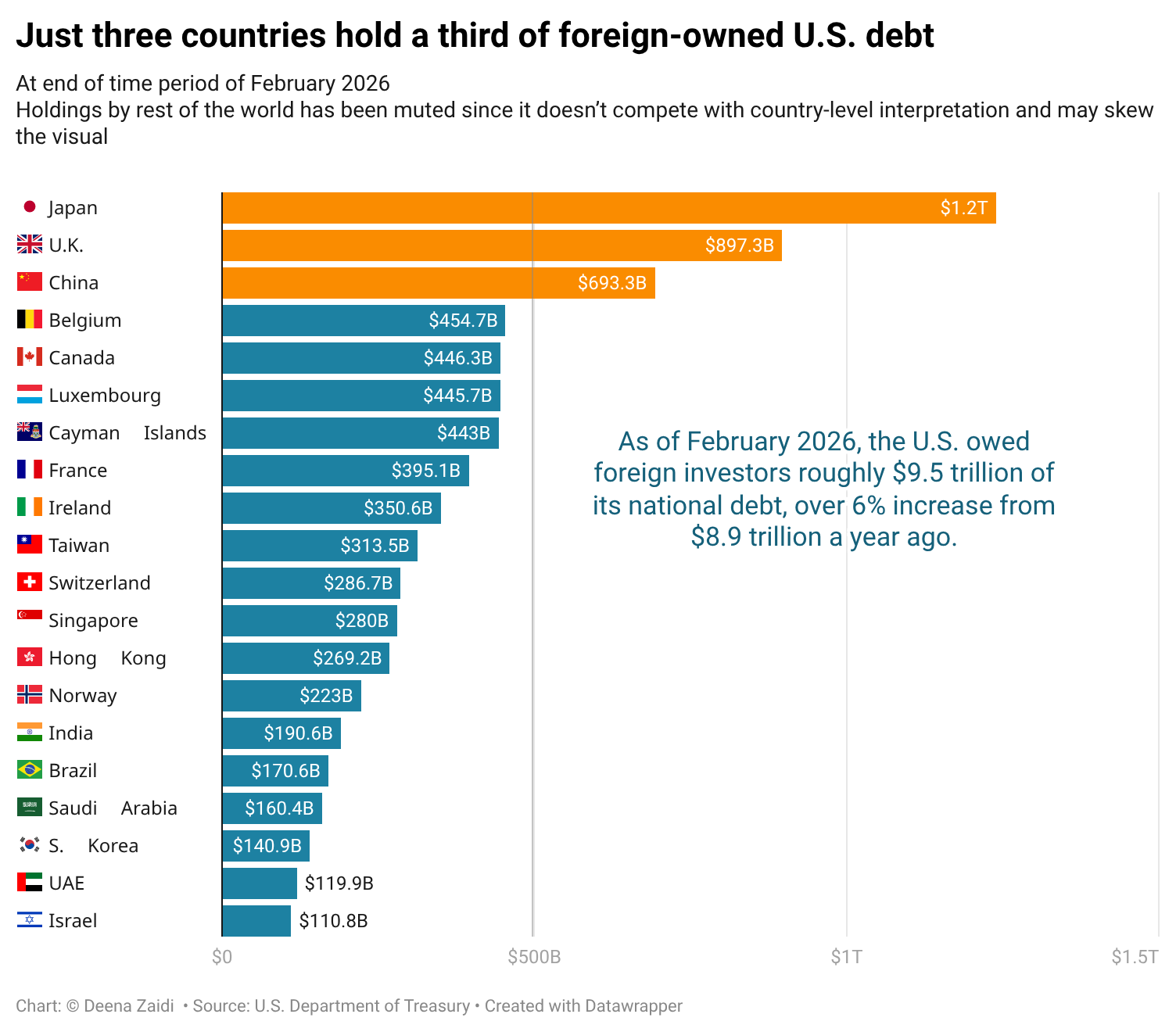
Japan, the U.K. and China together account for one-third of all foreign-owned U.S. debt, according to recent data released by the U.S. Department of the Treasury for February 2026.
Foreign investors held $9.5 trillion in U.S. Treasuries as of February 2026, up 6% from $8.9 trillion a year earlier, according to the Treasury International Capital (TIC) data, reflecting a continued global demand for U.S. assets despite rising borrowing costs.
Flows in February capture a mixed picture with foreign residents making net purchases of over $100 billion in long-term securities. At the same time, private foreign investors made net purchases of $147.3 billion, with foreign official institutions recording net sales worth $46.1 billion.
Saudi Arabia and Canada led gains in U.S. Treasuries as demand shifts beyond major holders
As of February 2026, Japan remained the largest foreign holder, with holdings of about $1.2 trillion, followed closely by the U.K. at roughly $897 billion.
Other countries that gradually added to their U.S. Treasury positions over the past one year included the U.K., United Arab Emirates (UAE), Canada, Norway, Belgium and France.
In February, some countries increased their exposure more aggressively than others, with Saudi Arabia increasing its holdings by 19% within a month, followed by one of America’s largest trading partner, Canada increasing its holdings by 13%.
Meanwhile, several emerging economies reduced their exposure to U.S. assets including China , India and Brazil. China’s holdings fell to about $784 billion in February last year to $693 billion in February this year.