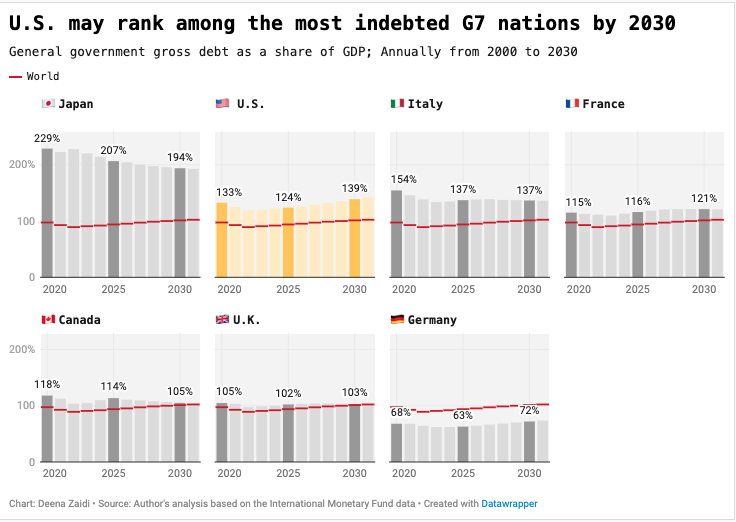
The world’s leading economy could be one of the most heavily indebted economies by the end of the decade, according to IMF estimates.
The recent release warns of the growing public debt, currently above 94% of GDP, is set to reach 100% by 2029, one year earlier than IMF’s April 2025’s projections.
This accumulation, the fund says, is driven largely by the world’s major economies such as Japan, Singapore, Italy, the U.K., France and Canada.
Rising debt means strain on finances. Of course in 2026, this picture is further complicated by the ongoing Middle East conflict and AI-era, adding layers of fragility and uncertainty.
After five years, the U.S. is projected to carry a heavier debt burden than five other G7 nations, second only to Japan. The ranking marks a big shift for the world’s largest economy, where the debt was once viewed as manageable due to the nation’s low borrowing costs and the dollar’s reserve currency status.
Why it matters
High debt levels do not trigger crisis automatically. But they can create long-term pressure through rising interest expenses, weaker fiscal flexibility and growing dependence on debt markets. That pressure becomes more significant if inflation remains sticky or interest rates stay elevated for longer.
Compared with other major advanced economies, the U.S. debt trajectory increasingly resembles countries long associated with structurally high debt burdens. In 2028, U.S. debt-per-GDP is set to surpass that of Greece.
But that does not mean that U.S. economy will resemble that of Greece or Japan. But it does mean it could move into a more constrained fiscal era.
Bottom line
By 2030, the U.S. may still be the world’s largest economy, but that does not mean it could not rank among the most indebted rich nations.