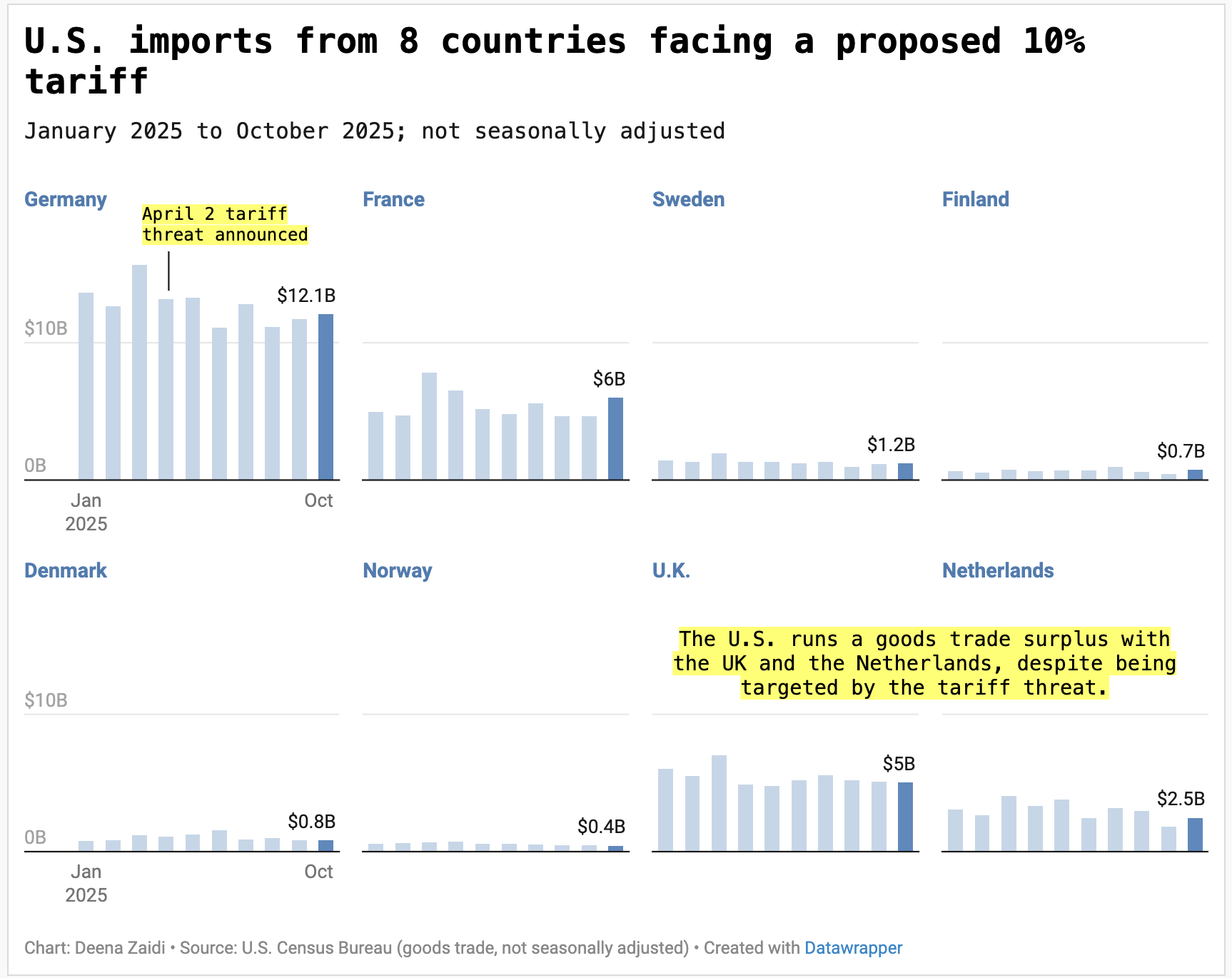
On January 17, 2026, Donald Trump announced he would impose a 10% tariff on imports from eight European countries — Denmark, Norway, Sweden, France, Germany, the UK, the Netherlands, and Finland — effective February 1, tied to their opposition to U.S. control of Greenland.
He said the tariff would rise to 25% by June 1 if no agreement is reached. The plan has drawn sharp criticism from European leaders and raised questions about its legality and impact on relations within NATO.
Trade status
According to U.S. Census Bureau, the U.S. runs goods trade deficit with Germany, France, Sweden, Finland, Denmark, and Norway (it imports more goods from these countries than it exports).
By contrast, the U.S. runs goods trade surpluses with the U.K. and the Netherlands, despite including both countries in the tariff threat.
The proposed tariffs would mark another escalation in Trump’s use of trade measures to pursue foreign-policy objectives. Previous trade actions by the administration have faced pushback from major partners including China, Brazil, and India.
In a post on Truth Social, Trump said the tariffs were retaliation for recent trips to Greenland by representatives from Britain, the Netherlands, and Finland, and for broader opposition to his efforts to purchase the semiautonomous territory, which is part of NATO ally Denmark.
The move could further threaten the already strained relationship between Trump and NATO allies. The alliance, dating back to 1949 was formed to provide a collective sense of security to Europe and North America.
What’s next?
It remains unclear how much impact this will have on the EU bloc comprising of 27 countries.
The UK, Denmark, Finland, France, Germany, the Netherlands, Norway and Sweden have issued a joint statement saying Trump’s threat risks a “dangerous downward spiral” and “undermines transatlantic relations”.
We stand in full solidarity with the Kingdom of Denmark and the people of Greenland. Building on the process begun last week, we stand ready to engage in a dialogue based on the principles of sovereignty and territorial integrity that we stand firmly behind.