During his State of the Union speech Tuesday night, President Trump announced what he described as a “new ratepayer protection pledge” related to tech companies building data centers to support artificial intelligence development.
We’re telling the major tech companies that they have the obligation to provide for their own power needs. They can build their own power plants as part of their factory, so that no one’s prices will go up.
— President Donald J. Trump’s 2026 State of the Union Address
making it the world’s largest data center market by a wide margin
Data centers are the backbone of digital infrastructure, and companies deploy these across the East, Central, and West regions of the country to ensure low latency and reliability.
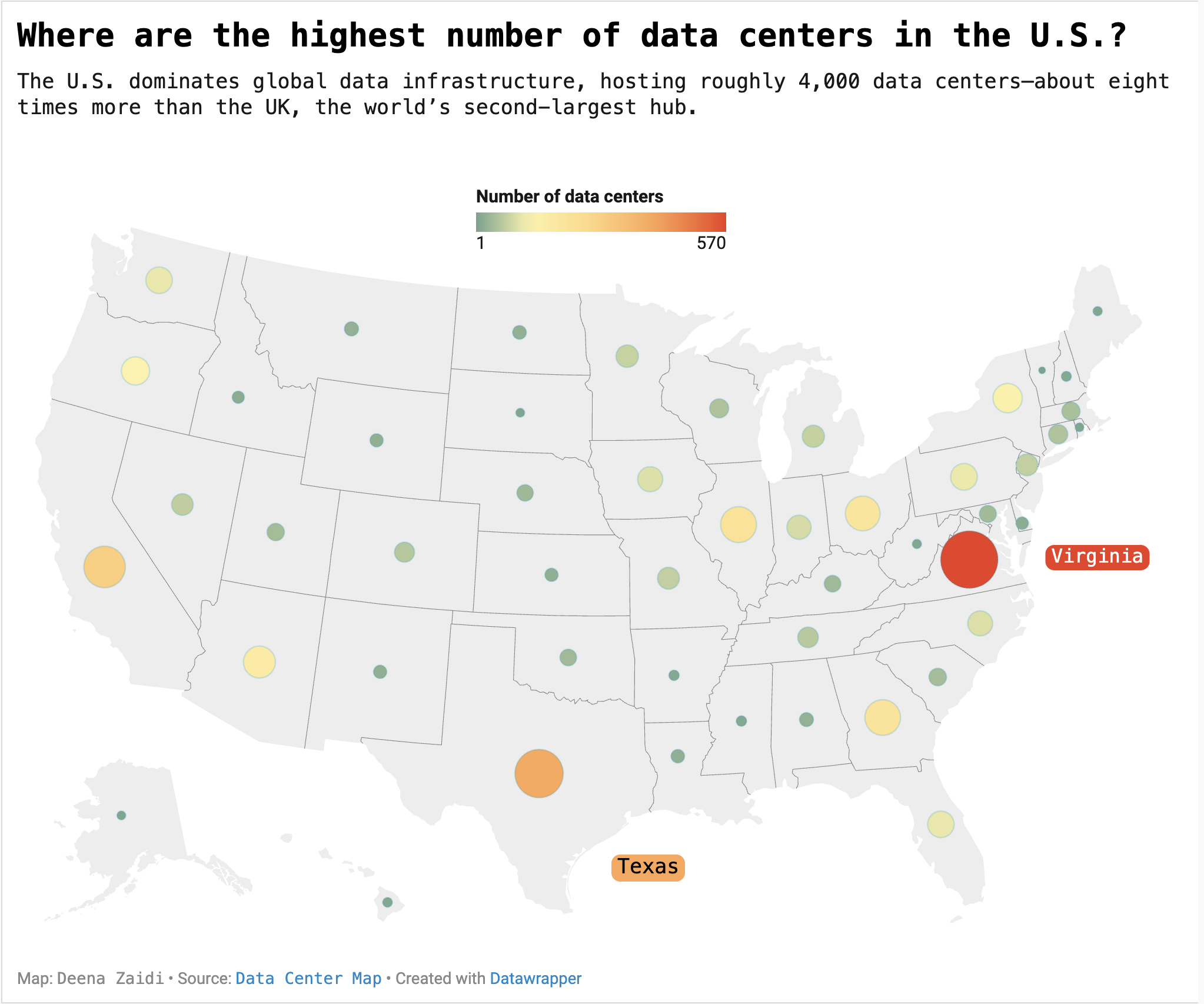
Virginia remains the dominant hub with a total of 570 data centers, including 128 in Ashburn. Northern Virginia has served as the industry’s central hub for more than 15 years, dating back to the early cloud computing days.
But Texas is gaining ground
That’s according to a report from JLL which shows the Lone Star could surpass Virginia by 2030. This year Big Tech which includes Amazon, Microsoft, Google, and Meta announced its plan to spend more than $600 billion on AI infrastructure expansion in 2026.
With power availability, land costs, and incentives driving site selection, Texas — now home to nearly 400 data centers — could emerge as a major growth frontier.
Currently, Dallas alone hosts 177 facilities, more than Ashburn.
Virginia’s dominance in data centers has been a known fact and the state is now planning an elevenfold increase in computing capacity, with nearly 35 gigawatts of projects in development that will help preserve its dominance.
According to JLL’s report, Tennessee, Ohio, Wisconsin, and Texas are now considered the top emerging markets for data centers, and are already capitalizing on abundant energy resources, and ample land availability.

What’s next?
The next wave of data center growth will hinge on power.
The U.S. electricity demand is entering its fastest sustained growth phase in decades — driven largely by data centers and AI infrastructure.
According to the U.S. Energy Information Administration (EIA), U.S. electricity use will grow by 1% this year and 3% in 2027 — the strongest four-year growth period since 2000—driven by a surge in increasing demand from large computing centers.
- JLL’s reports Texas overtaking Northern Virginia as the world’s largest data center market in the next five years- thanks to “abundant energy resources, ample land availability and a business-friendly operating environment support this trajectory”.
- Much of the 35 gigawatts under construction is already shifting beyond the traditional hubs as developers chase available electricity, lower costs and faster grid connections.
- With demand still outpacing supply, the race to host AI and cloud infrastructure will increasingly be decided by which regions can deliver reliable energy at scale.
Suggested reads:
- Charting the data center development roadmap in key US states
- The Electricity Supply Bottleneck on U.S. AI Dominance
- JLL’s North America Data Center Report Year-end 2025
- Trump’s Expected SOTU ‘Rate Payer Protection Pledge’ on Data Centers Is Nonsense